Not-so-traditional Pork Belly Souvlaki
I love souvlaki. But pork belly souvlaki? This is the one I get properly excited about. This is exactly the sort of meal I love putting on the table when we have family or friends over.
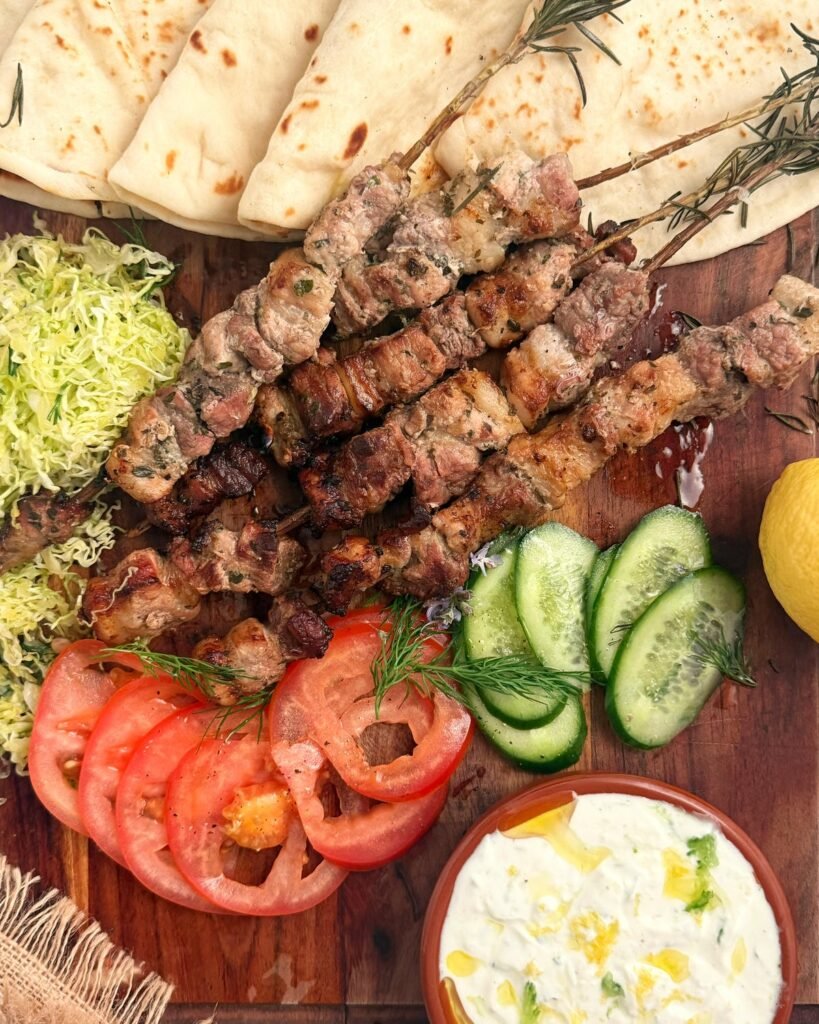
I don’t want to stand there making everyone a perfectly assembled individual wrap. Absolutely not. I bring out a big platter of pork belly skewers, a stack of warm homemade flatbreads, a bowl of homemade tzatziki, salads, lemon wedges and whatever else we’ve decided to throw onto the table.
Everyone builds their own.
Somebody will inevitably put too much pork into one flatbread. Someone else will use half the bowl of tzatziki. The kids will probably eat the flatbread by itself.
That’s kind of dinner that memories are made from.
And while traditional Greek pork souvlaki is usually made with pork shoulder, I deliberately use pork belly.
It’s fattier. It’s juicier. It’s more forgiving on the grill. And when you cook it slowly first so that fat begins to render before finishing it over hotter flames?
Ohhh yes.
You get smoky and ridiculously tender pork.
Why you’ll love this pork belly souvlaki
- It’s ridiculously juicy. Pork belly has enough fat that you have a much bigger margin for error than with lean pork.
- You get crispy AND tender pork. Low heat renders the fat; higher heat at the end gives you the char.
- The marinade is incredibly simple. No hunting around for twelve spices you’re going to use once and then discover at the back of the cupboard in 2029.
- You can cook it on almost anything. Charcoal, wood, gas BBQ or a hot plate will all work.
Why I use pork belly for souvlaki
Pork shoulder makes fantastic souvlaki and is the more traditional choice.
But if I’m standing around the BBQ with a drink in my hand and a pile of skewers in front of me, I want pork belly.
The extra fat completely changes the experience.
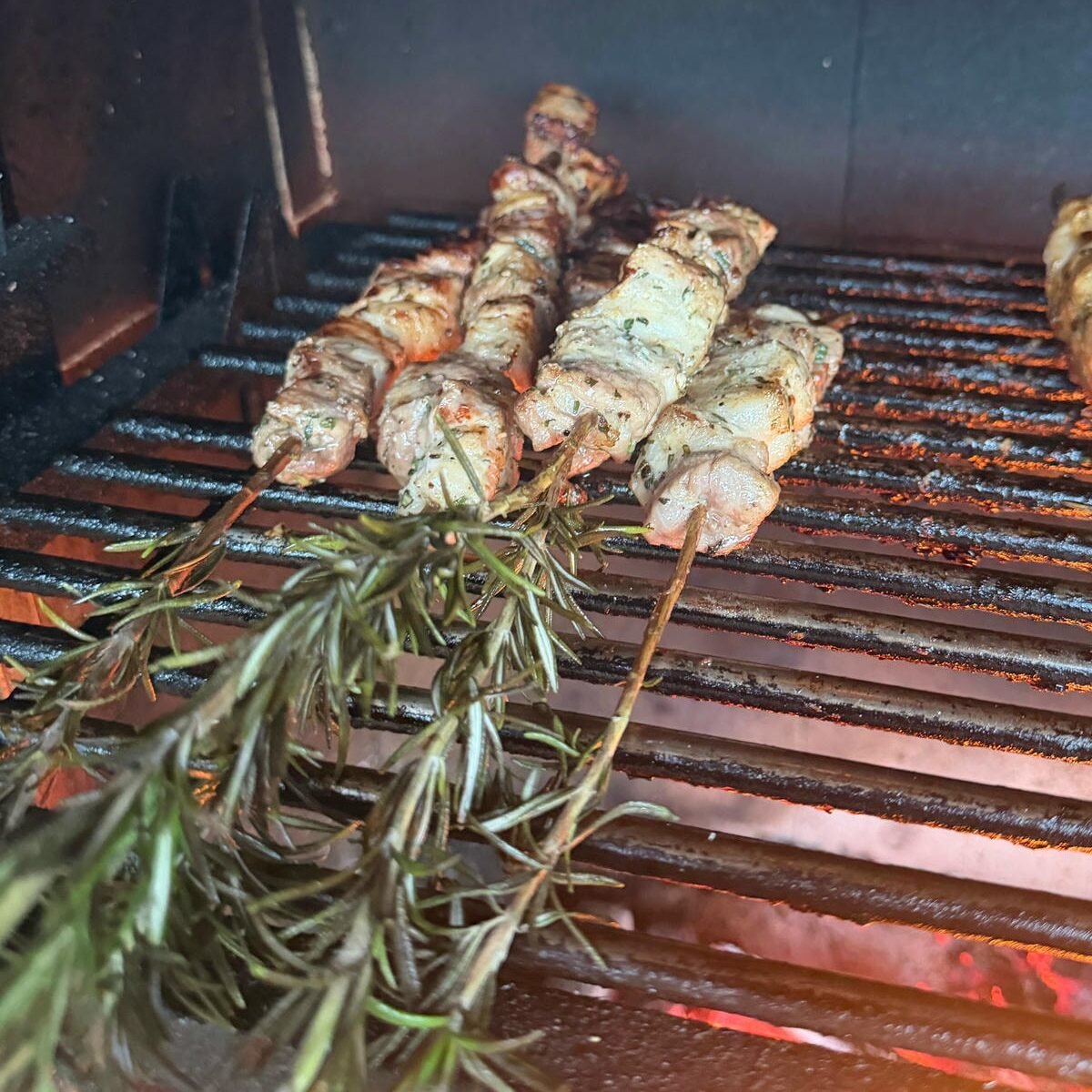
As the skewers slowly cook, the fat softens and renders. Some drips onto the charcoal or wood below. You get little flare-ups. Smoke rolls around the meat. The edges start turning golden.
And because there is so much fat running through the pork, the inside stays beautifully juicy.
That is exactly why I don’t attack these skewers with screaming-high heat from the beginning.
Pork belly rewards patience.
Cook it gently. Let the fat render. Let the smoke do its thing.
Then turn up the heat and give it some punishment.
Another bonus is the longer it takes to cook these beauties, the few more beers, wine or Aperol Spritz you can have 🙂
Keep the marinade simple
There’s another thing I don’t want to do to good pork belly: bury it under seventeen different ingredients.
Pork belly already tastes incredible.
So this marinade is deliberately simple: onion, garlic, oregano, lemon, salt and pepper.
That’s it.
There’s no heavy sauce covering everything up. The marinade gives the pork some garlic, oregano and acidity while still letting it taste unmistakably like pork.
The grated onion is particularly important.
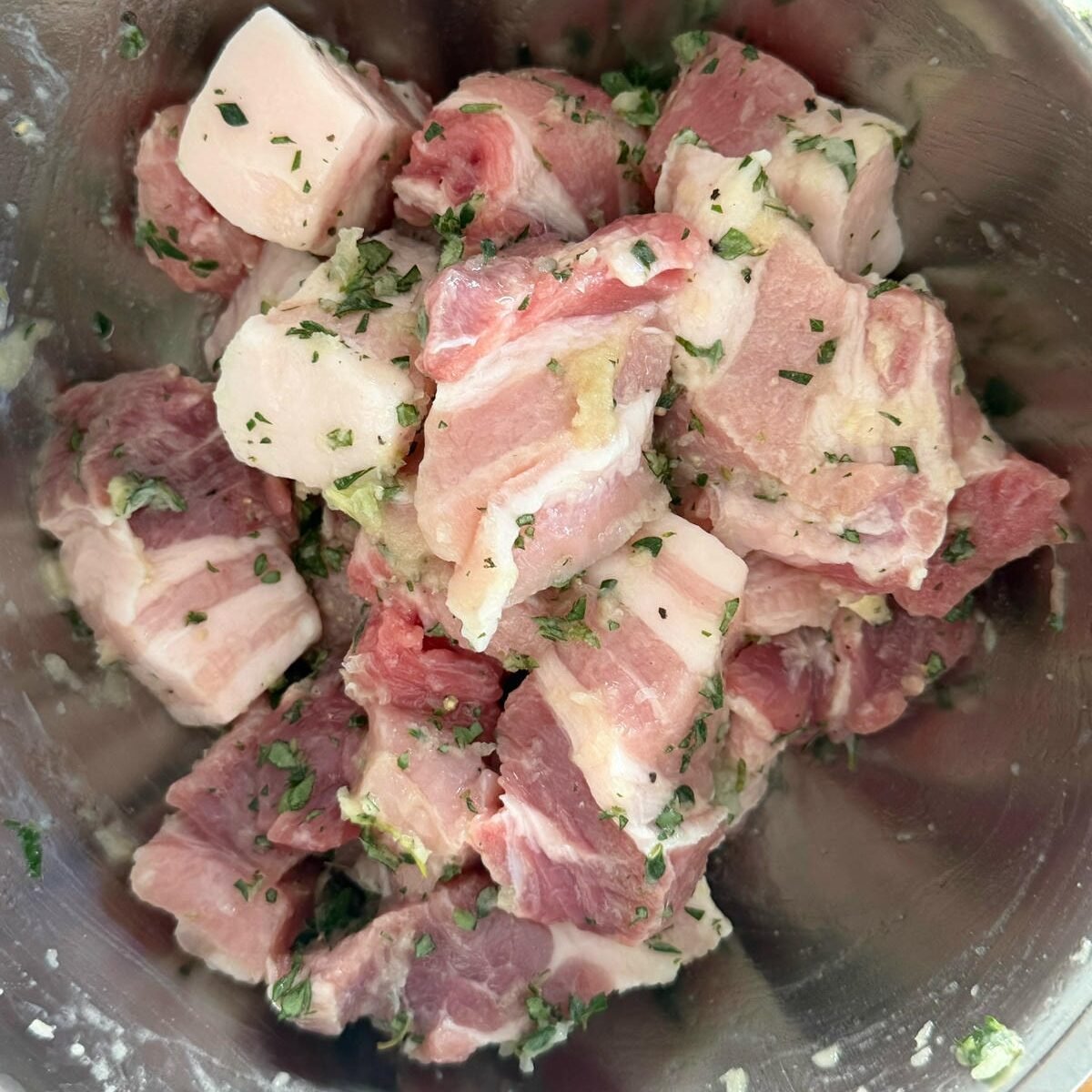
Rather than chopping it, I grate half an onion directly into the marinade. You get all of that onion juice coating every little cube of pork rather than chunks of onion sitting between them.
Massage everything together, put it in the fridge and walk away for a couple of hours.
Dinner is already heading in the right direction.
Ingredients
For the pork belly souvlaki
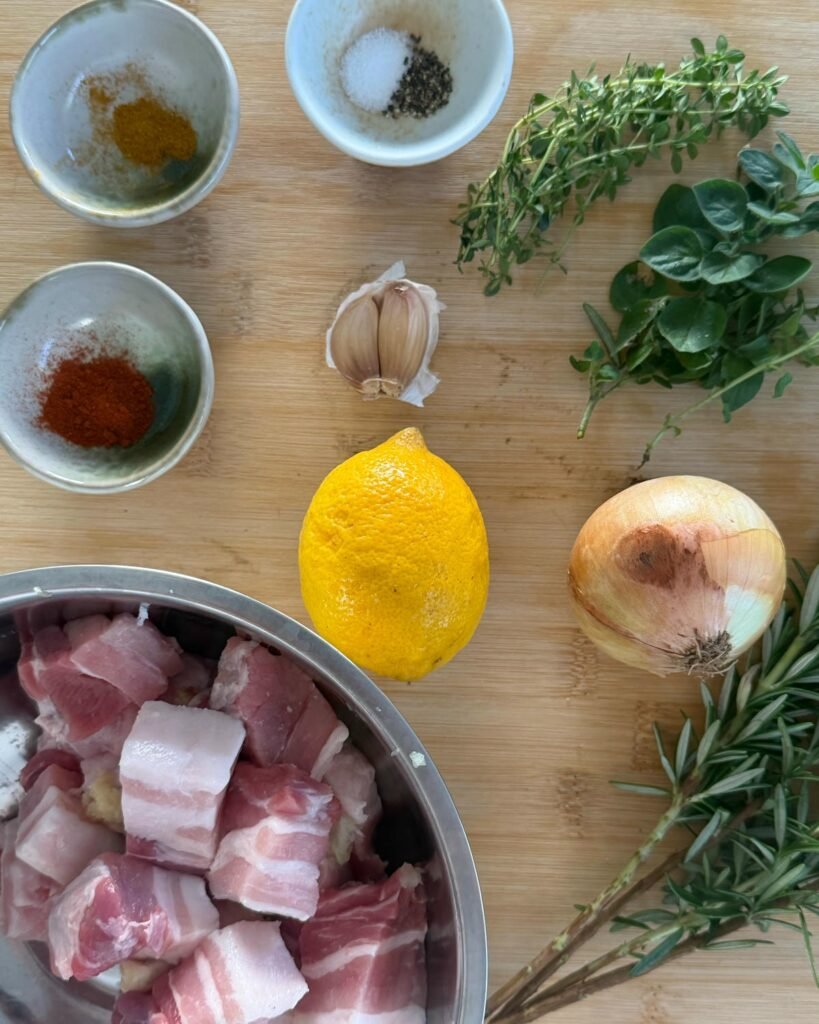
- 1kg pork belly
- 1/2 onion, grated
- 3–4 garlic cloves, grated
- 1 tablespoon fresh oregano, finely chopped, or 1 teaspoon dried oregano
- Juice of 1 lemon
- 1–1 1/2 teaspoons salt, or to taste
- Freshly cracked black pepper
To serve
- Homemade flatbread
- Homemade tzatziki
- Tomato and cucumber salad or Greek salad
- Sliced onion
- Lemon wedges
A few things before you start
Cut the pork belly into small cubes
I cut my pork belly into roughly 1.5cm x 1.5cm cubes.
That might seem quite small compared with some chunky souvlaki skewers, but there is a reason.
We’re dealing with pork belly.
Smaller pieces give us more surface area for rendering, smoke and charring. Try to keep the pieces roughly the same size so they cook evenly.
Grate the onion – don’t just chop it
This is such a simple trick but it makes a noticeable difference.
When you grate an onion, you break it down and release loads of juice. That juice gets all over the pork and carries that sweet onion flavour throughout the marinade.
You aren’t looking for noticeable pieces of onion on the finished skewer. You want its flavour worked into the pork.
I grate the garlic for exactly the same reason.
Fresh or dried oregano?
Either.
If I’ve got fresh oregano growing outside, I’ll use it. It gives the marinade a lovely fresh herbal smell.
But dried oregano is absolutely fine and, realistically, it’s probably what most of us already have sitting in the pantry.
Don’t let the lack of fresh oregano stand between you and pork belly souvlaki.
How to make pork belly souvlaki
1. Cut the pork belly
Slice the pork belly into approximately 1.5cm cubes.
Remove the skin but DO NOT remove all the fat.
I repeat: do not remove all the fat.
The fat is half the reason we’re using pork belly in the first place.
If there’s an unusually huge lump hanging off one piece, sure, trim it. Otherwise leave that beautiful marbling alone.
2. Make the marinade
Grate half an onion into a large bowl.
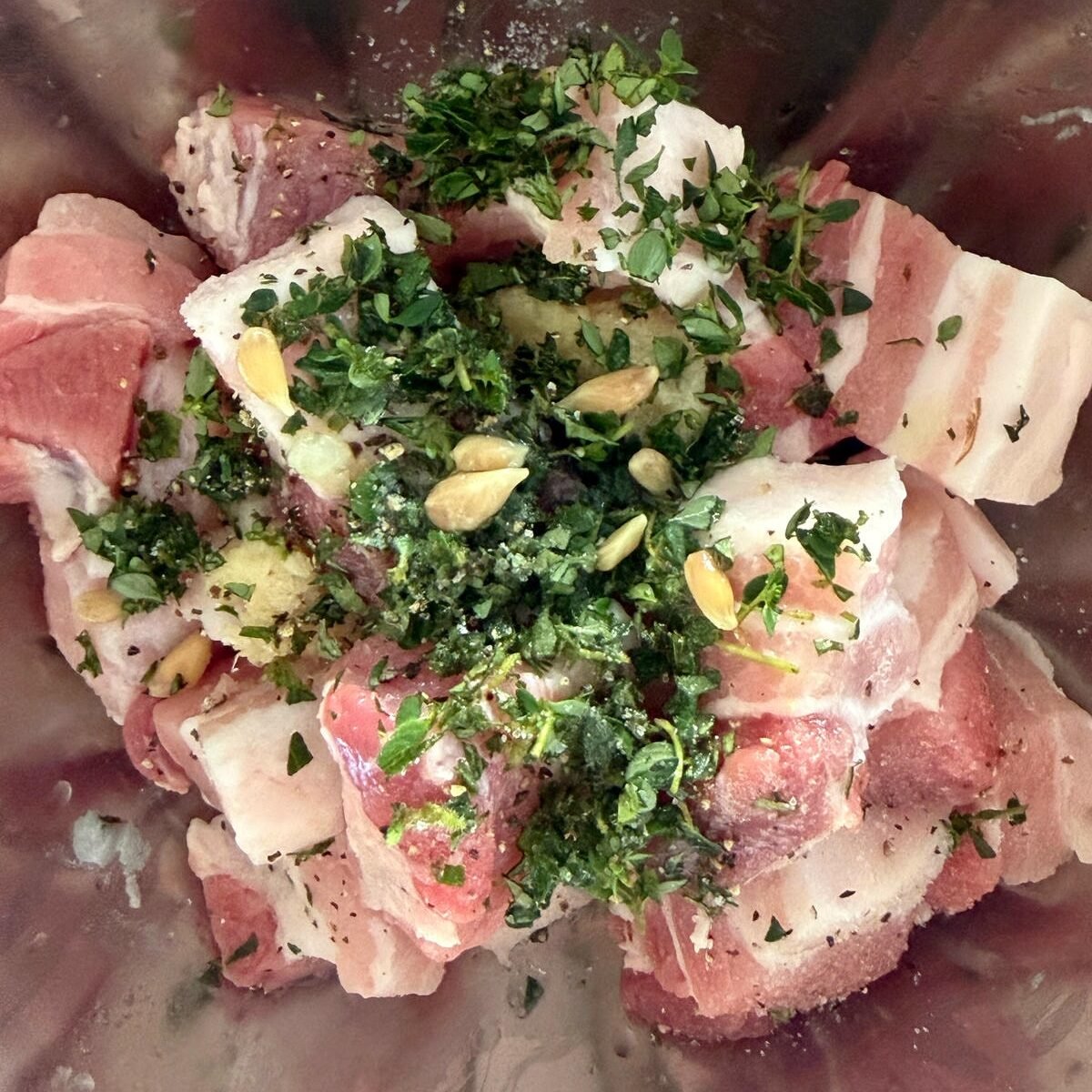
Grate in the garlic, then add the oregano, lemon juice, salt and plenty of freshly cracked black pepper.
Add the pork belly cubes and get your hands in there.
Massage everything thoroughly so every piece of pork is coated in the onion and garlic juices.
Cover and refrigerate for at least 2 hours and up to 24 hours.
If I’m organised, I’ll do this the night before. If I’m not – which happens – two or three hours still gives you fantastic pork.
3. Skewer the pork
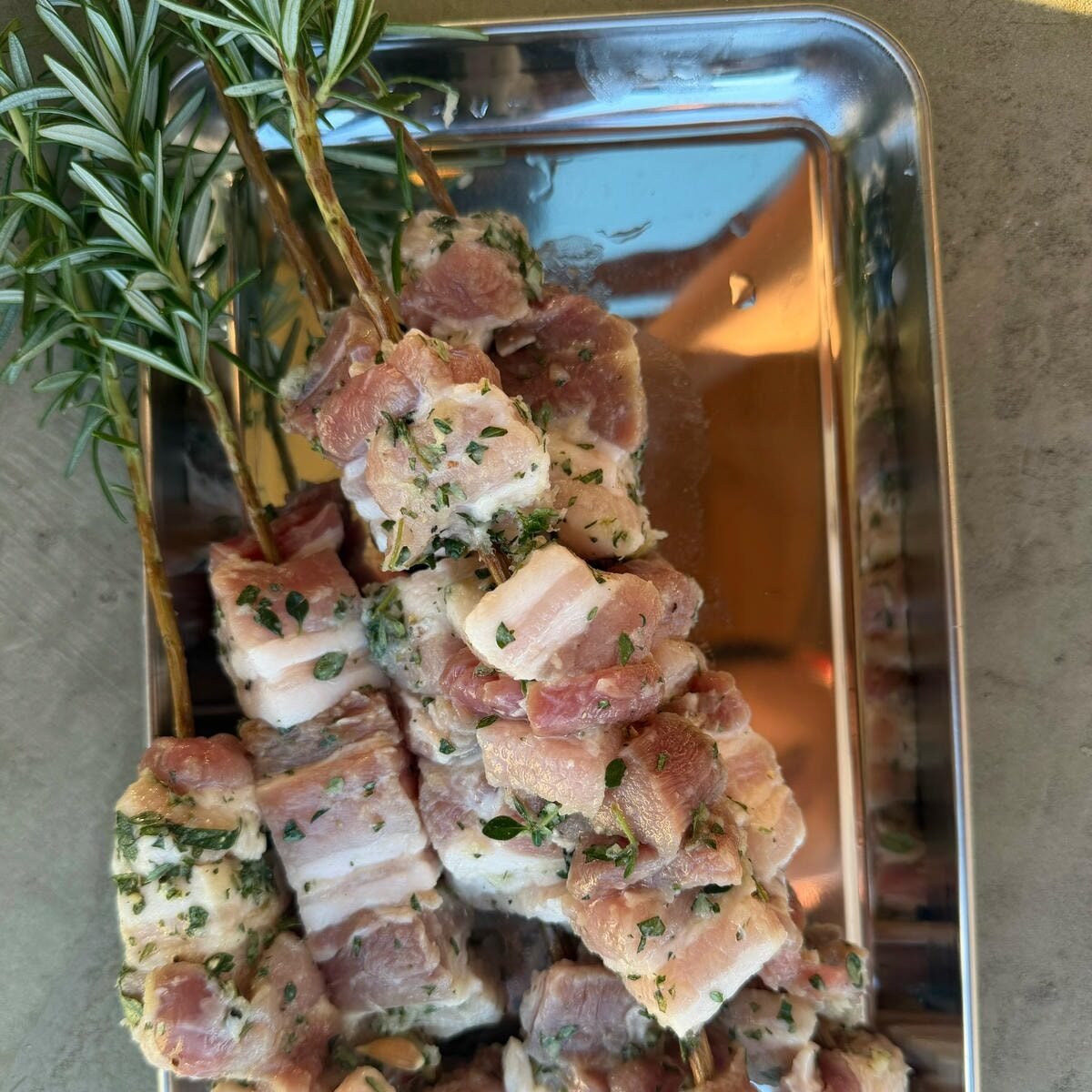
Thread the pork belly onto your skewers.
Don’t squash the pieces together into one giant pork sausage. They can sit snugly against each other, but you still want heat and smoke to work their way around the meat.
If you’re using bamboo skewers, soak them in water for at least 15 minutes first. Otherwise there’s a decent chance you’ll finish dinner with perfectly cooked pork attached to several tiny campfires.
But here’s a fun alternative.
If you’ve got a big, established rosemary bush, use the woody rosemary stems as skewers.
Strip off most of the leaves and thread the pork straight onto the stems. They’re sturdy, they don’t need soaking and you get a little extra rosemary aroma around the pork as it cooks.
Plus it looks fantastic piled onto a serving platter.
4. Start low and slow
Now we cook.
Wood fire is fantastic.
Charcoal is fantastic.
Gas BBQ works.
A hot plate works.
Use whatever you’ve got.
The important part isn’t obsessing over the fuel. It’s how you manage the heat.
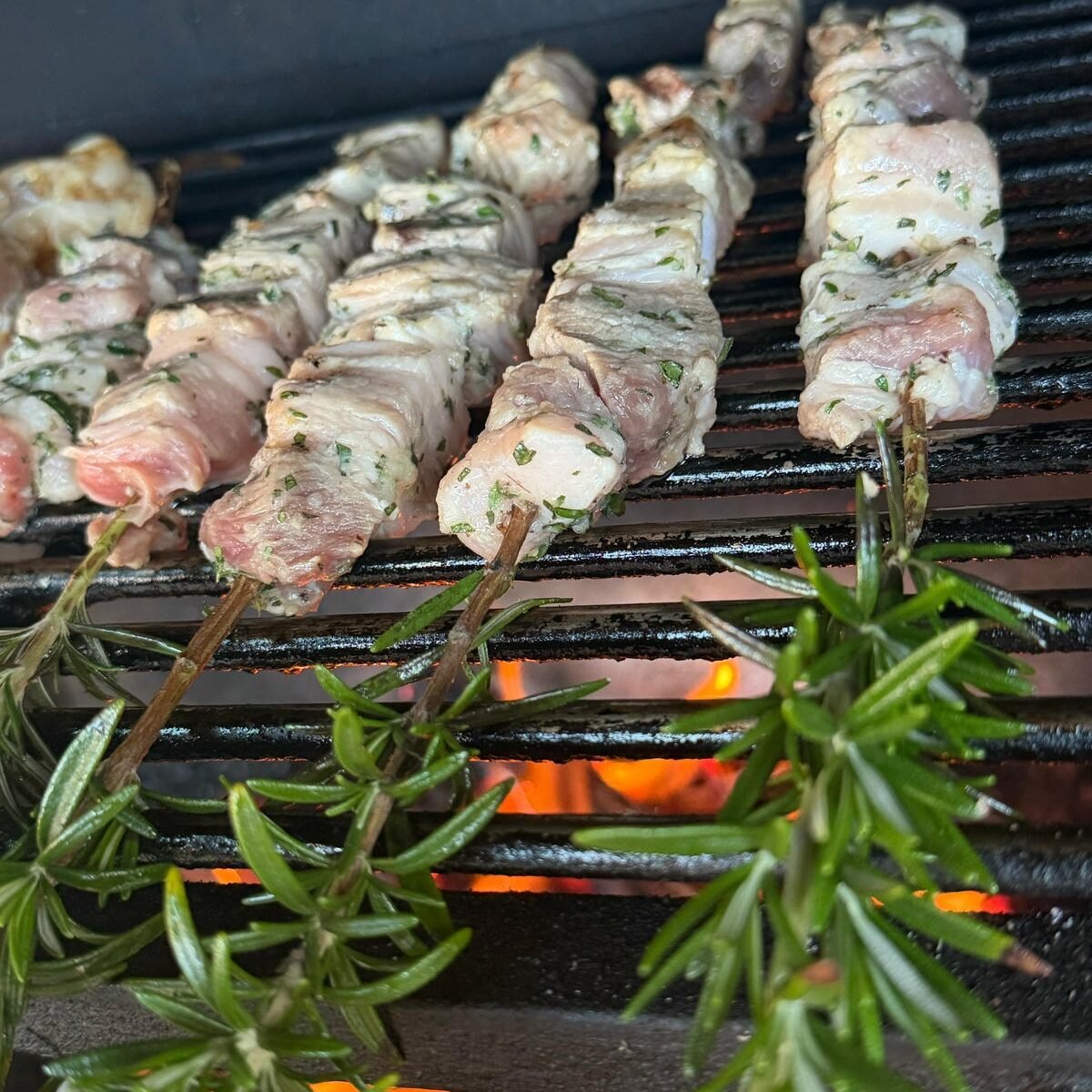
Start with relatively low heat and, if your BBQ has one, close the hood.
Cook the skewers slowly for around 20–30 minutes, turning them every 5–10 minutes.
We’re not chasing dark grill marks yet.
We’re rendering.
As the pork belly warms up, the fat begins to soften and drip. Over charcoal or wood, some of that fat will hit the coals and you’ll get little bursts of flame and smoke.
Perfect.
Don’t panic every time you see a flame.
Move the skewers if they’re sitting in a raging inferno, obviously, but a few flare-ups licking around the pork are part of what makes grilled pork belly so bloody good.
Let it take on that smoke.
Let the fat render.
Let the inside cook gently without drying out.
5. Now give it some heat
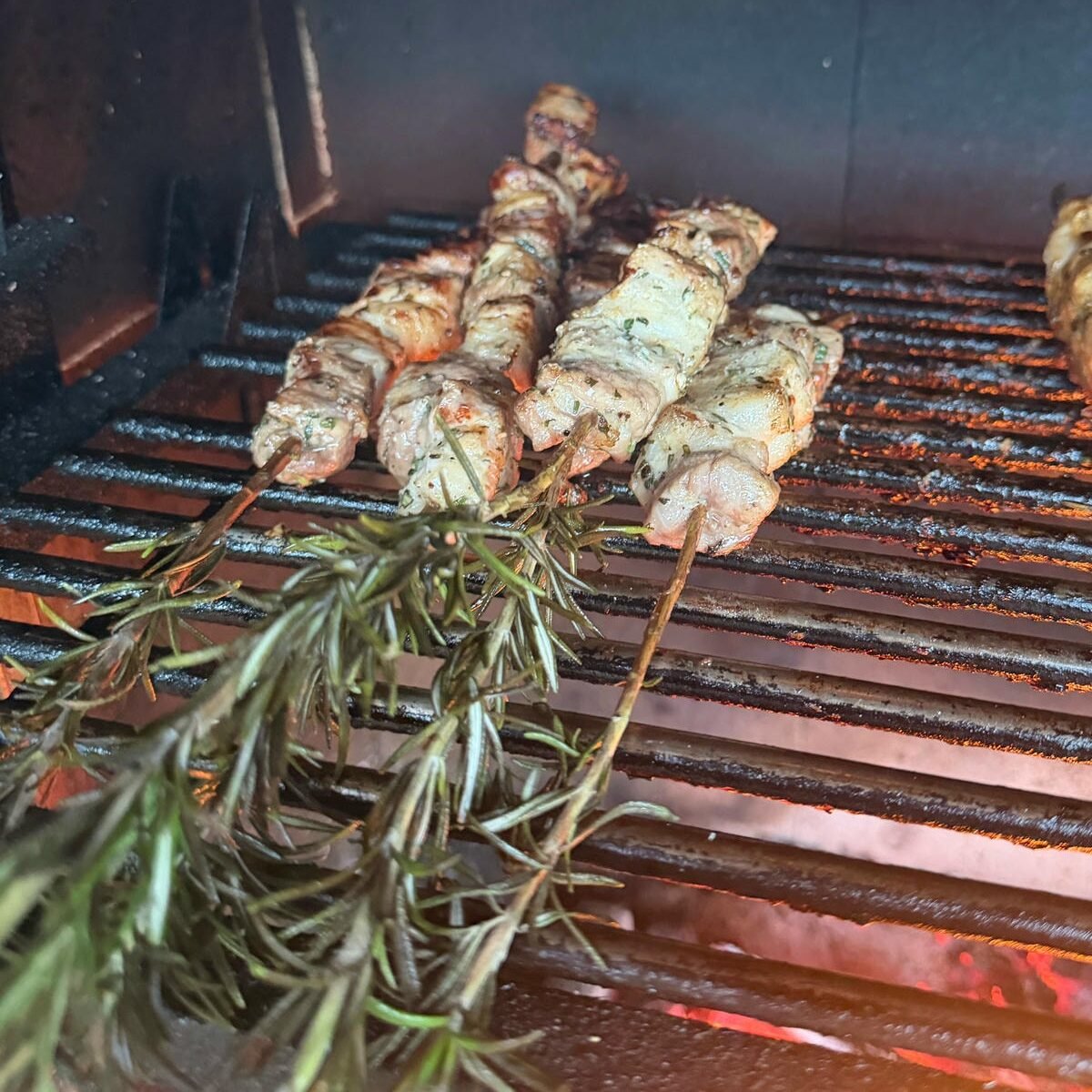
Once the pork reaches around 60°C internally, have a look at it.
Is it beautifully golden with crispy edges and enough char?
Great. You’re almost there.
But if it still looks a bit pale with not charring, increase the grill to medium-high heat and start turning the skewers more frequently.
This part happens quickly.
The rendered exterior fat will crisp, the edges will darken and you’ll start getting those little charred bits that everyone fights over.
You’re looking for golden-brown pork with darker smoky edges rather than completely black skewers.
Use your thermometer and cook the pork to a safe final temperature. For whole cuts of pork, 63°C followed by a short rest is a useful minimum benchmark, although with fatty pork belly souvlaki I often take it a little further because I’m chasing more rendered fat and crispy edges.
Don’t cook by colour alone.
A thermometer is cheap. Pork belly isn’t.
6. Get it straight onto the table
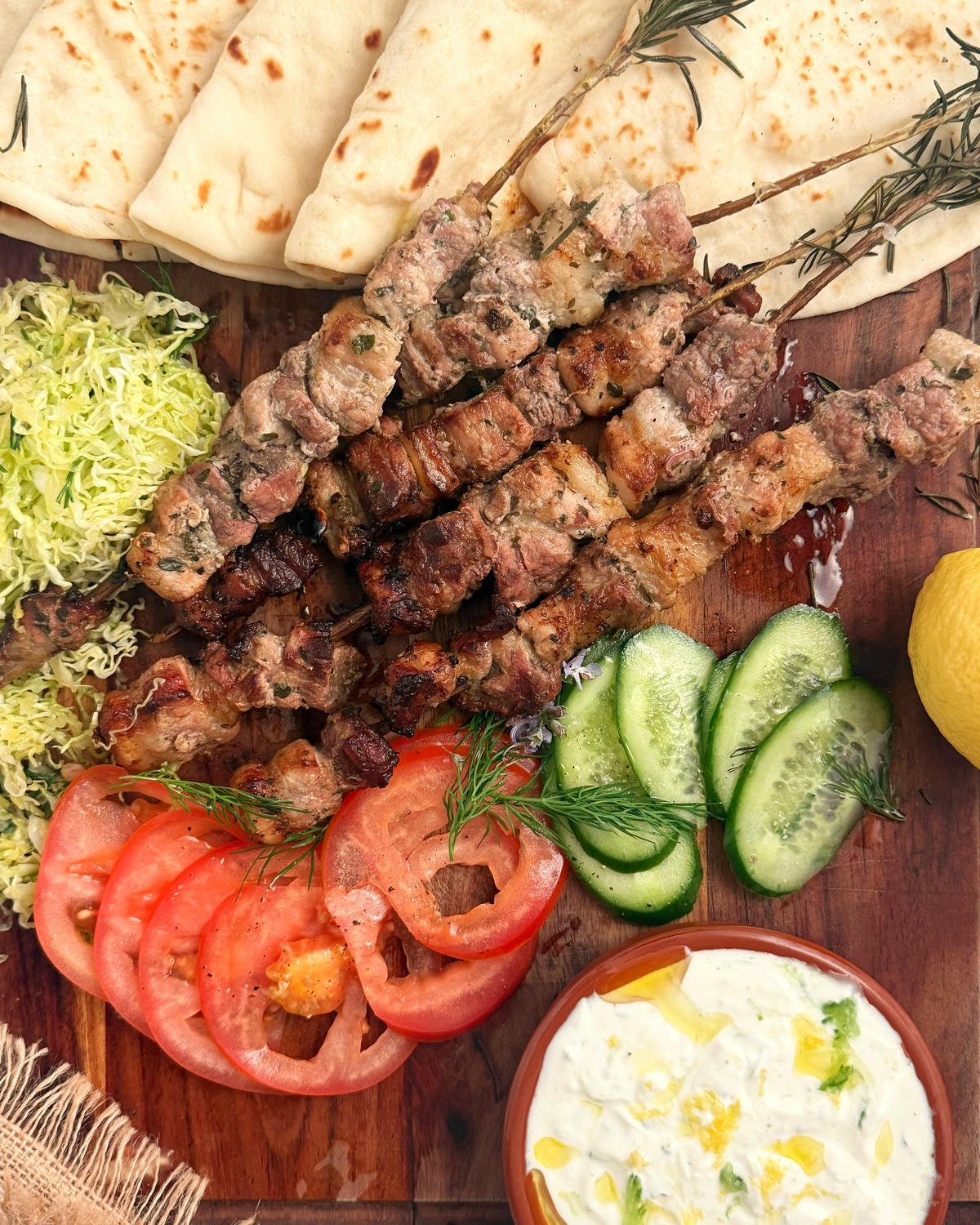
Transfer the finished skewers onto a big serving platter.
Then squeeze fresh lemon over the whole lot while it’s still hot.
This is usually the point where I have to “test” a piece before carrying the platter to the table.
Quality control.
Very important.
Charcoal vs wood vs gas
If you have charcoal or wood, use it.
Pork belly and live fire were clearly meant to meet each other.
The dripping fat hits the coals, smoke comes back up around the skewers and you get a flavour that’s difficult to completely reproduce on gas.
But I don’t want this to become one of those recipes where I tell you that unless you own a particular $2,000 BBQ and imported charcoal, dinner is cancelled.
Gas works. A hot plate works. Even a cast-iron grill pan will get you there.
You’ll lose some of the smoke, but you’ll still have juicy pork belly with oregano, garlic, lemon and crispy edges.
That’s hardly a tragedy.
Build a proper souvlaki spread
This is my favourite way to eat this recipe.
Forget individually plating everything.
Put the lot in the middle of the table.
I serve the pork belly with a big bowl of cold, garlicky homemade tzatziki, warm homemade flatbread, chopped tomato, cucumber, onion, salad and plenty of lemon wedges.
Then everyone makes their own.
Tear off a flatbread.
Slather on tzatziki.
Pull a few pieces of smoky pork belly from the skewer.
Add tomato, cucumber and onion.
More tzatziki.
Squeeze of lemon.
Fold.
Attempt to eat it without losing half the filling onto your plate.
That’s souvlaki night at our place.
And if we’re having a bigger group over, I’ll usually add a platter of chicken souvlaki as well. Pork belly for the people who understand what’s good in life, chicken for everyone else.
I’m kidding.
Mostly.
Frequently asked questions
Isn’t pork shoulder more traditional for souvlaki?
Yes. Pork shoulder is a traditional and excellent choice for Greek pork souvlaki.
I use pork belly because I love the extra fat. It keeps the meat incredibly juicy and gives you gorgeous crispy edges once that fat renders over the grill.
This isn’t about saying pork shoulder is wrong. I just happen to think pork belly is ridiculously good cooked this way.
Can I use pork shoulder instead?
Absolutely.
Use the same marinade and cooking principle, although pork shoulder is leaner than belly and won’t need quite as much time to render fat.
How long should I marinate the pork?
At least 2 hours is my recommendation.
You can marinate it for up to 24 hours, which makes this perfect for preparing the night before.
Do I have to use charcoal?
No.
Charcoal or wood will give you the best smoky flavour, but a gas BBQ or hot plate works perfectly well.
The most important thing is controlling the heat: gentle cooking first, then hotter grilling at the end for colour and crispiness.
Why is my pork belly burning?
You’re probably starting with too much heat.
Pork belly contains a lot of fat, and once that starts dripping onto charcoal or flames, things can get exciting very quickly.
Keep the first part of the cook relatively low and move the skewers away from major flare-ups. Once the pork is nearly cooked and some fat has rendered, finish over higher heat.
What should I serve with pork belly souvlaki?
For me, the essentials are warm flatbread, tzatziki and something fresh and crunchy.
My full souvlaki spread usually includes:
- Pork belly souvlaki
- Chicken souvlaki
- Homemade Greek flatbread
- Homemade tzatziki
- Tomato
- Cucumber
- Sliced onion
- Salad
- Lemon wedges
Put everything in the middle and let people build their own dinner.
Much more fun.
Pork Belly Souvlaki
Ingredients
Method
- Cut the pork. Cut the pork belly into approximately 1.5cm cubes, leaving the fat intact.
- Marinate. Add the grated onion, garlic, oregano, lemon juice, salt and pepper to a large bowl. Add the pork belly and massage thoroughly until coated. Cover and refrigerate for at least 2 hours or up to 24 hours.
- Prepare the skewers. If using bamboo skewers, soak them in water for at least 15 minutes. Thread the pork belly pieces onto the skewers. Alternatively, use sturdy woody rosemary stems.
- Cook slowly. Preheat a charcoal, wood or gas grill to low heat. Add the skewers and close the hood if available. Cook for approximately 20–30 minutes, rotating every 5–10 minutes, allowing the pork fat to slowly render.
- Check the temperature. Once the centre of the pork reaches around 60°C, check the exterior. If it needs more colour, increase the grill to medium-high.
- Char and finish. Grill over the higher heat, turning regularly, until the pork develops crispy golden edges and darker charred spots and reaches a safe final internal temperature.
- Serve. Transfer immediately to a platter and squeeze over fresh lemon. Serve with warm flatbread, homemade tzatziki, salad and extra lemon wedges.
Nutrition
Tried this recipe?
Let us know how it was!Common questions
Enjoy 🙂 – Damo